In Scotland, doctors are now writing nature into their prescriptions.
On the Shetland Islands, GPs recommend walks, birdwatching, and time by the water as a first-line treatment for stress, anxiety, and cardiovascular strain. Not as a supplement to medication. As a primary intervention.
This is not alternative medicine. It is neuroscience catching up with what the Japanese have understood for centuries, what indigenous cultures have practised for millennia, and what every person who has ever stood at the edge of the ocean already knows in their body: that certain environments heal us in ways that no room, no screen, and no schedule can replicate.
The question is not whether nature is medicine. The evidence for that is now overwhelming. The question is which prescription is right for you — and whether you are choosing your environment with the same rigour that you choose everything else in your life.
You cannot think your way out of a depleted nervous system.
You have to travel your way out of it.
I advise clients who, by any conventional measure, have achieved everything. Founders who built companies from nothing. Executives who run organisations of thousands. People whose judgment other people depend on, daily, at scale.
And what I see, beneath the achievement, is a particular kind of exhaustion that conventional holidays do not touch. It is not tiredness. It is the accumulated weight of years of full cognitive occupation — every available space filled with input, decision, and responsibility. The nervous system is running, permanently, at a frequency it was never designed to sustain.
When I begin a travel consultation, I rarely ask where they want to go. I ask what they need their body to feel like on the flight home. And then I prescribe accordingly.
There are, in my experience, three environments that address this exhaustion at its root. Each corresponds to a different mode of restoration. Each is most effectively accessed in a specific way.
The Land Prescription — The Healing Forest
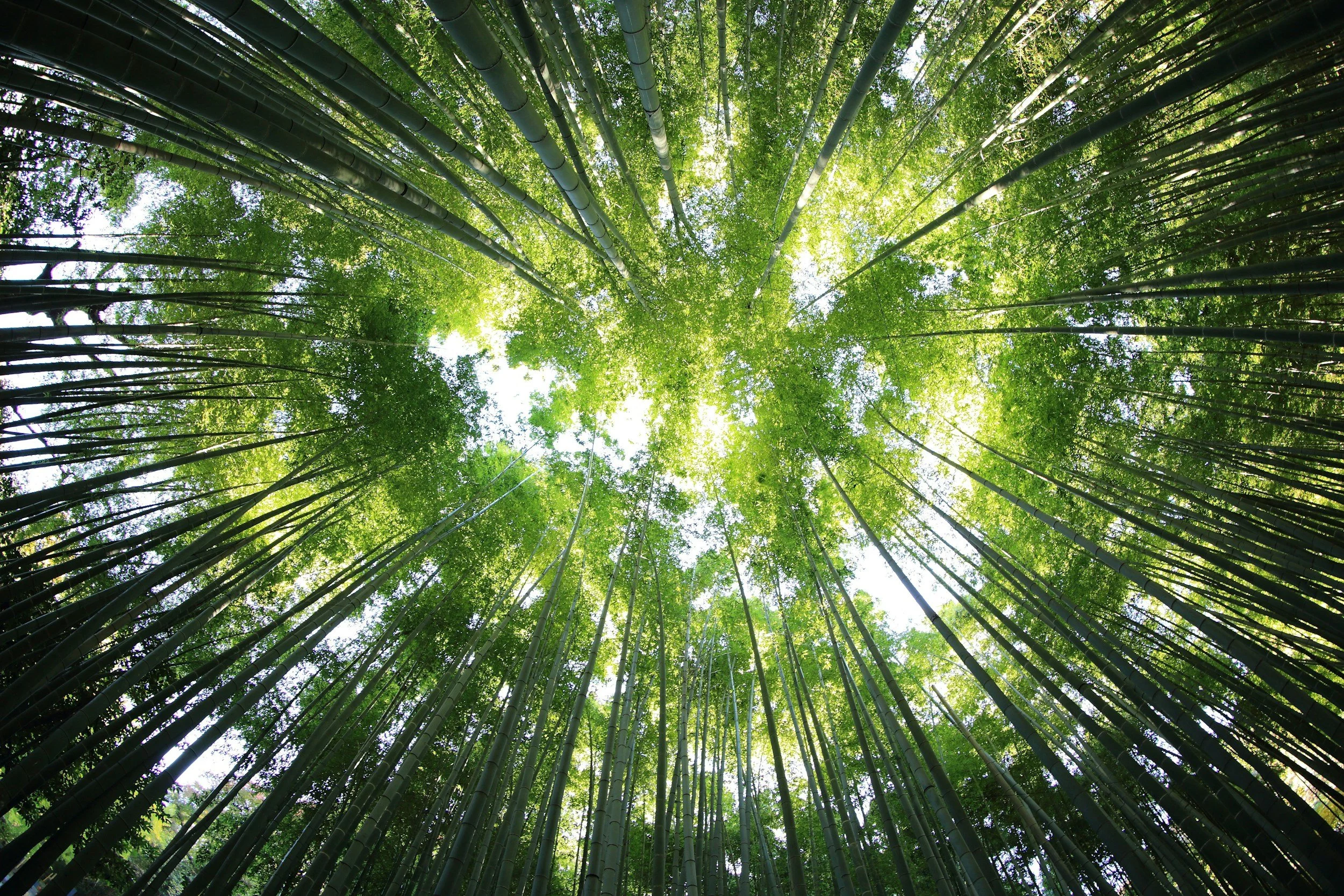
In 1982, the Japanese Ministry of Agriculture coined the term Shinrin-yoku — forest bathing. Not as a leisure activity, but as a public health initiative. The research behind it is now substantial: time in forest environments measurably reduces cortisol levels, lowers blood pressure, increases natural killer cell activity, and produces a sustained improvement in mood that outlasts the visit by days.
The mechanism is partly chemical. Trees release phytoncides — organic compounds with antimicrobial properties that, when inhaled, trigger measurable changes in the immune system. But it is also attentional. The forest demands a different quality of awareness — soft, diffuse, receptive — that is the neurological opposite of the focused, narrow attention that executive work requires.
After hours of narrow focus, the forest does not ask you to focus differently. It asks you to stop focusing altogether. To notice without deciding. To receive without processing.
The most powerful land prescription I advise on is the ancient cedar forests of Koyasan — the sacred mountain temple complex south of Osaka, where Buddhist monks have lived in contemplative practice for over twelve centuries. The air carries incense, cedar resin, and altitude. The paths between the 117 temples are lined with moss so old it has its own silence.
You do not need to be religious to feel what Koyasan does to the nervous system. You need only to walk slowly enough to notice it.
The forest does not ask you to focus differently.
It asks you to stop focusing altogether.
For clients who want to experience the land prescription within a structured itinerary, I advise on private journeys through Japan that include a minimum of two nights in Koyasan — enough time for the altitude, the silence, and the rhythm of the monks' day to begin to do their work.
I also advise on land-based wellness itineraries through Iceland, where geothermal landscapes produce a version of the same effect: an environment so primordially powerful that the human nervous system has no option but to recalibrate around it.
The Ocean Prescription — The Blue Mind
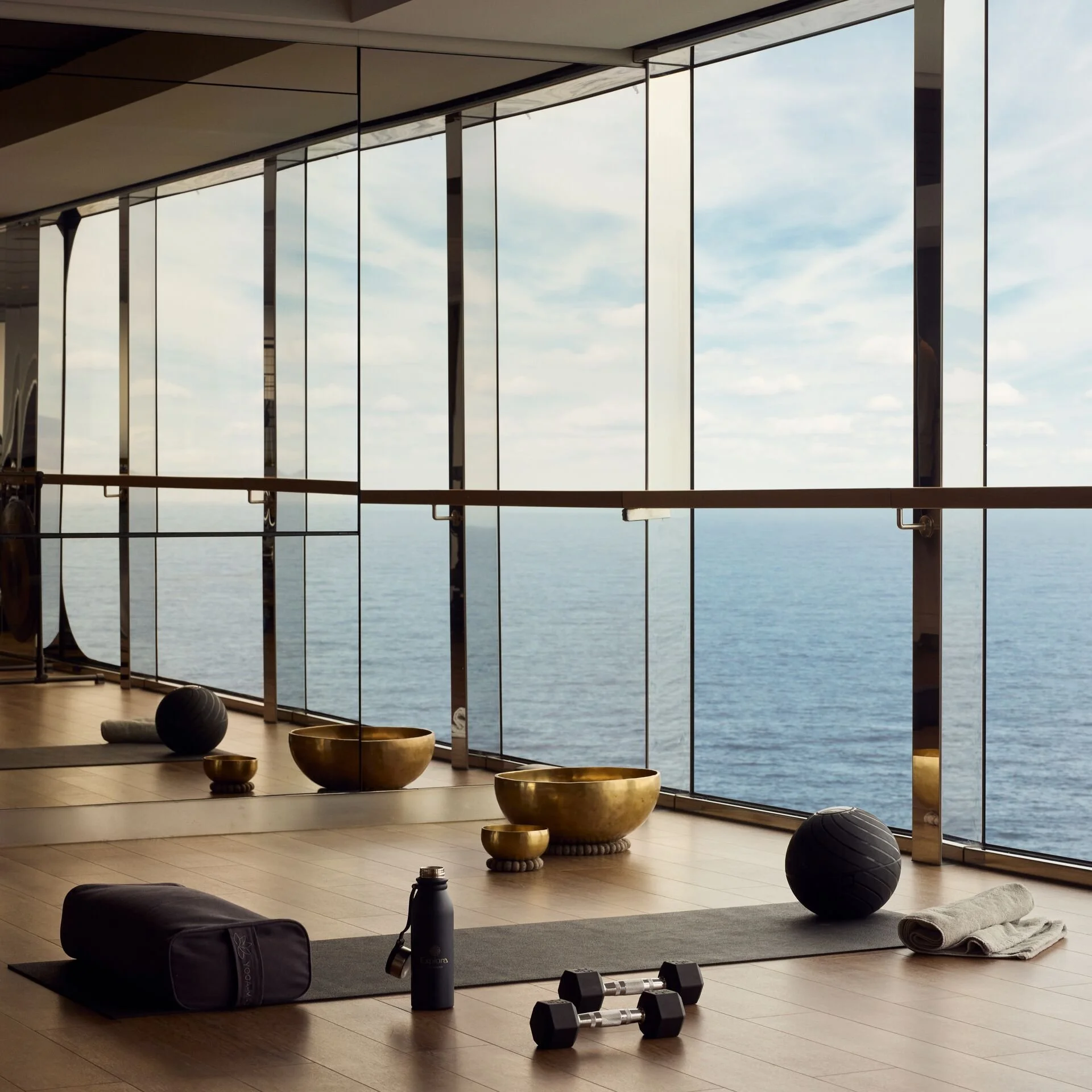
Image: courtesy of Explora Journeys
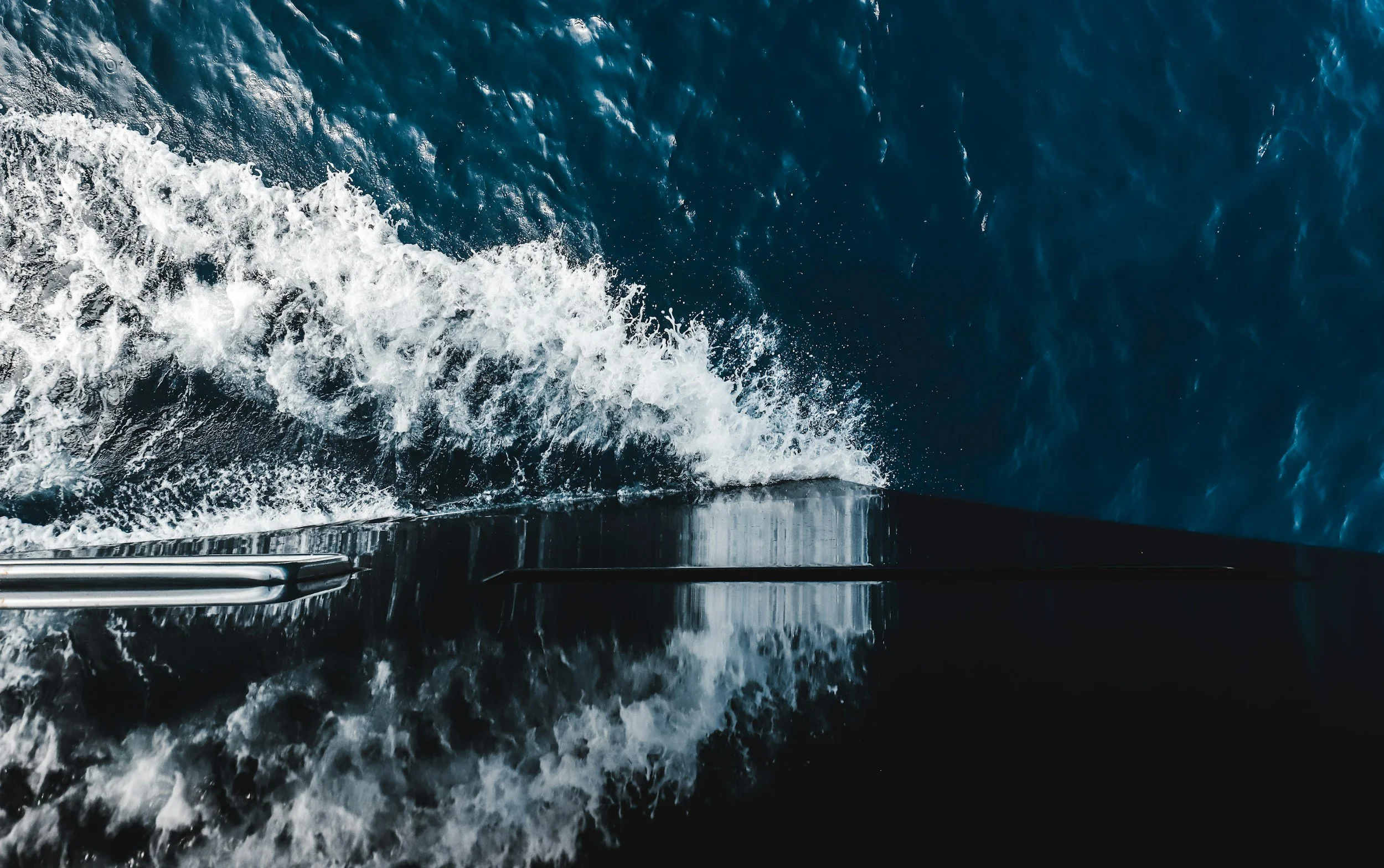
Marine neuroscientist Wallace J. Nichols coined the term Blue Mind to describe a mildly meditative state triggered by proximity to water. The research supporting it has accumulated steadily since his 2014 book of the same name: people consistently report lower stress, greater creativity, and a sustained sense of calm when near, in, or on the ocean.
The mechanism here is partly sensory — the sound of water triggers the parasympathetic nervous system, the physiological state associated with rest and recovery. But it is also spatial. The ocean offers the eye a horizon so vast and uncluttered that the visual system, accustomed to the density of screens and cities, can finally rest.
There is nothing to process on the open ocean. Nothing to decide about. The water does not send notifications.
I have spent years at sea professionally — aboard the Ritz-Carlton Yacht Collection's Evrima and, before that, as Future Cruise Sales Manager on HX Hurtigruten Expeditions' F. Nansen in Antarctica. What I observed, repeatedly, was that guests who had been unable to sleep properly for months were sleeping deeply by the third night at sea. Not because of the schedule or the food or the luxury of the cabin — but because the ocean, quite simply, gave their nervous systems permission to stop.
The water does not send notifications.
It simply moves, and in doing so, gives the mind permission to do the same.
The ocean prescription I most frequently advise on is not a beach resort. It is a small-ship ocean voyage — expedition or ultra-luxury — where the relationship with the water is continuous rather than incidental. Not a backdrop to the pool bar, but the entire environment, shifting and present, from dawn to dark.
Explora Journeys. The Ritz-Carlton Yacht Collection. SeaDream Yacht Club for the intimacy of a private yacht at the scale of a small ship. HX Hurtigruten for those whose prescription requires something stronger — the polar silence of the Arctic or Antarctic, where the Blue Mind effect is amplified by a landscape so ancient and so vast that the self becomes, briefly and beneficially, very small.
The Air Prescription — Clarity at Altitude

Image: courtesy of Four Seasons Jet
The air prescription is the most counterintuitive of the three, because it is also the most associated with the problem it is meant to solve.
For most executives, flying is not restorative. It is an extension of the working day — compressed, disrupted, and conducted in an environment designed for transit rather than transition. The airport, the queue, the middle seat, the recycled air, the six-hour delay, the seven emails sent from the gate — the experience of flying, as most people know it, is precisely the opposite of medicine.
But the experience of flying the Four Seasons Private Jet is not what most people know.
The aircraft — a custom Airbus A321, the first of its kind configured exclusively for private expeditions — carries 48 guests in fully flat seats, with Four Seasons hotel staff, food and beverage, and service standards that match any of the company's finest properties. There is no airport. No queue. No overhead locker negotiation. The transition from ground to air is as considered and frictionless as the arrival at a great hotel.
What this produces, neurologically, is something I can only describe as a clean start. The usual associations of air travel — stress, compression, loss of control — are simply absent. What remains is the sky, the horizon, and the particular quality of light at altitude that has always, for those sensitive to it, produced a feeling of perspective impossible to manufacture on the ground.
I have watched clients board the Four Seasons Private Jet still carrying the tension of the week — shoulders raised, jaw set, phone in hand — and watched that tension begin to dissolve somewhere over the North Atlantic, as the altitude does quietly what no amount of willpower could do faster.
True luxury in the air is not the seat or the service.
It is arriving at your destination already restored — not in need of recovery from the journey itself.
The air prescription is most powerful as part of a multi-destination expedition — the Around the World itineraries operated by TCS World Travel in partnership with Four Seasons, or the signature Japan expedition I advise on each year, which uses the private jet not merely as transport but as a threshold — the moment of crossing from one world into another.
Which prescription is yours?
The most honest answer is that most people who come to me need all three, in sequence, over time.
But if I were to offer a starting point based on what I observe most frequently in the clients I advise, it would be this:
If you cannot sleep — the ocean. The continuous, unpredictable, undemanding presence of open water is the most reliable nervous system reset I know.
If you cannot think clearly — the land. Specifically, the ancient forest. Koyasan. The Icelandic interior. The cedar silence of a ryokan garden. Environments that require nothing of you except presence.
If you cannot let go of control — the air. Specifically, an environment so carefully managed that there is nothing left to control. The Four Seasons Private Jet. The expedition vessel in the Antarctic. Contexts in which the decision to trust has already been made for you, and the only thing left to do is inhabit the journey.
In all three cases, the prescription is the same at its root: an encounter with an environment more powerful than your schedule, your responsibilities, and the accumulated noise of a life lived at full output.
The world has always been medicine. The question is only whether you are willing to let it work.
— Monika Norvilaite
Founder, Aura Vera · Virtuoso-Affiliated Luxury Travel Advisor
Describe the feeling. I will find the place.
→ Begin the conversation at aura-vera.com