The Art of Observing
What birdwatching teaches us about presence, patience, and the particular kind of attention that transforms a journey into something that lasts.
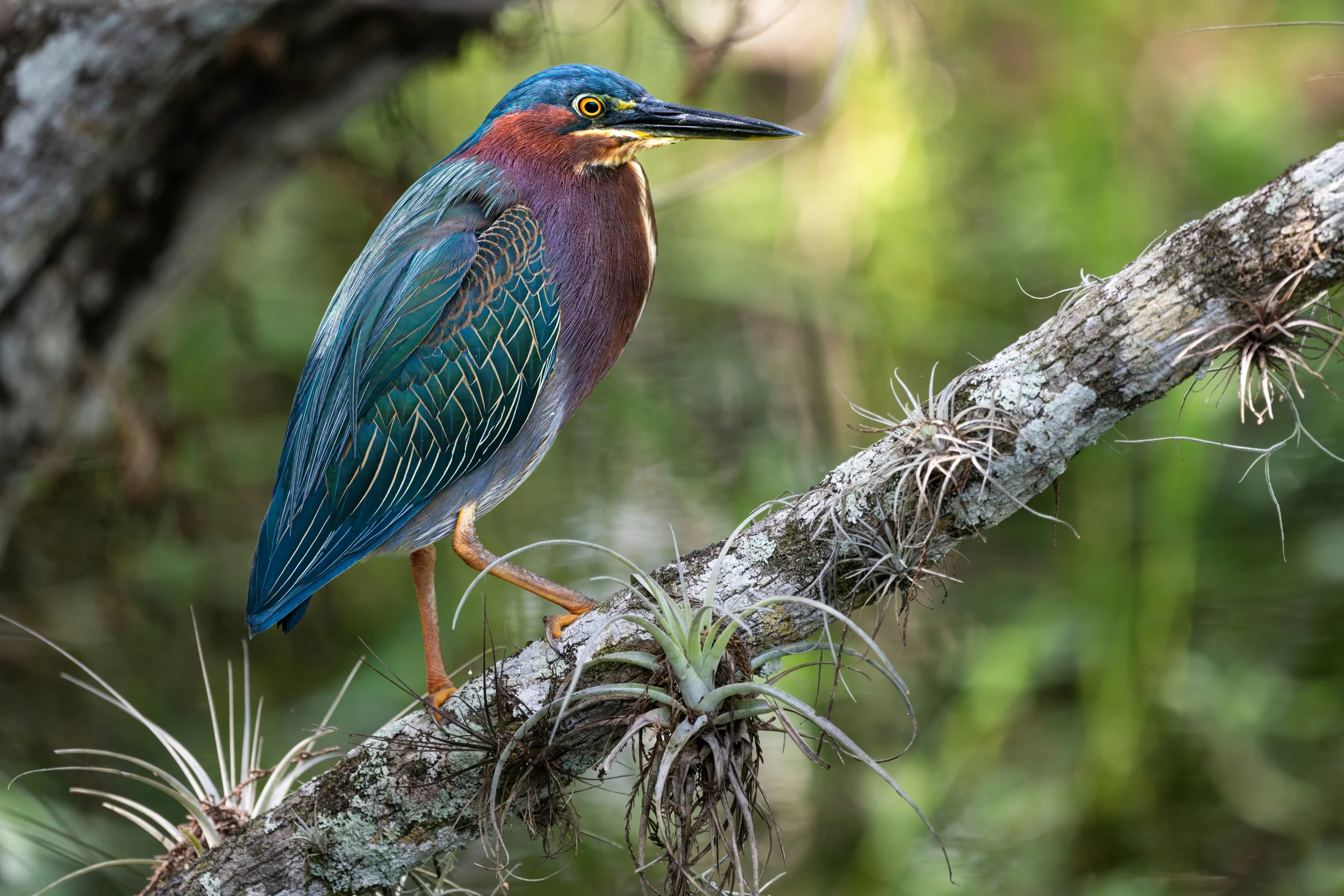
The Green Heron — iridescent, unhurried, and entirely indifferent to being one of the most beautiful birds in the Americas.
There is a moment that every serious birdwatcher describes the same way. You have been walking for an hour, scanning the canopy, hearing calls you cannot yet place. And then — stillness. A flash of colour in the high branches. You raise your binoculars. And for a few seconds, the world contracts to a single point of extraordinary, utter attention.
Nothing else exists. Not the meeting you postponed to be here. Not the decision you have been carrying for three months. Not the ambient noise of a life lived at high velocity. Just this — a bird you have never seen, in a place you will never forget, doing nothing more remarkable than existing.
This is what birdwatching actually is. Not a hobby. Not a retirement pursuit. A practice of radical presence — one of the very few activities that demands your full attention and rewards it with something that cannot be purchased, manufactured, or optimised.
The bird does not perform for you. It simply is.
And to see it, you have to become still enough to deserve the encounter.
I have spent years working with high-performing clients — executives, founders, family office principals — people whose professional lives require them to process enormous complexity at speed. What I observe, again and again, is that the journeys which change them are not the ones with the most impressive itineraries. They are the ones that create the conditions for a different quality of attention.
Birdwatching, done properly, in the right place, with the right guide, is one of the most powerful ways I know to create those conditions. And the places that offer it at the highest level are among the most extraordinary on Earth.
What birdwatching actually is — for those who have never tried
If you have never birdwatched seriously, the concept can feel inaccessible. Let me offer a simple framework.
At its most basic, birdwatching — or birding, as its practitioners prefer — is the observation of birds in their natural habitat. But that description misses everything important about it. What it is, in practice, is a structured invitation to pay attention.
Birds are extraordinarily sensitive to disturbance. They do not appear on demand. They are not impressed by status or schedules. To see the birds worth seeing — the endemic species, the rare migrants, the ones that exist in only one place on Earth — you must slow down, quiet your mind, and learn to read an environment that operates entirely on its own terms.
A good naturalist guide transforms this completely. They hear a call and know immediately what made it, where it is, and how close you need to be. They understand the behaviour patterns of each species — when they feed, where they nest, and what time of day they move. With the right guide, in the right place, you are not searching. You are being introduced.
The 'life list' — the record of every species you have ever seen — is the birdwatcher's version of collecting. Some pursue it casually. Others with remarkable dedication. The Galápagos alone offers the famous 'Galápagos 15' — fifteen endemic species found nowhere else on Earth, each one the product of millions of years of isolated evolution.
When you see a blue-footed booby for the first time — truly see it, close enough to count its eyelashes — something resets. You remember that the world is vast and largely indifferent to your concerns, and that this is an extraordinary relief.
Three places where birdwatching reaches another level
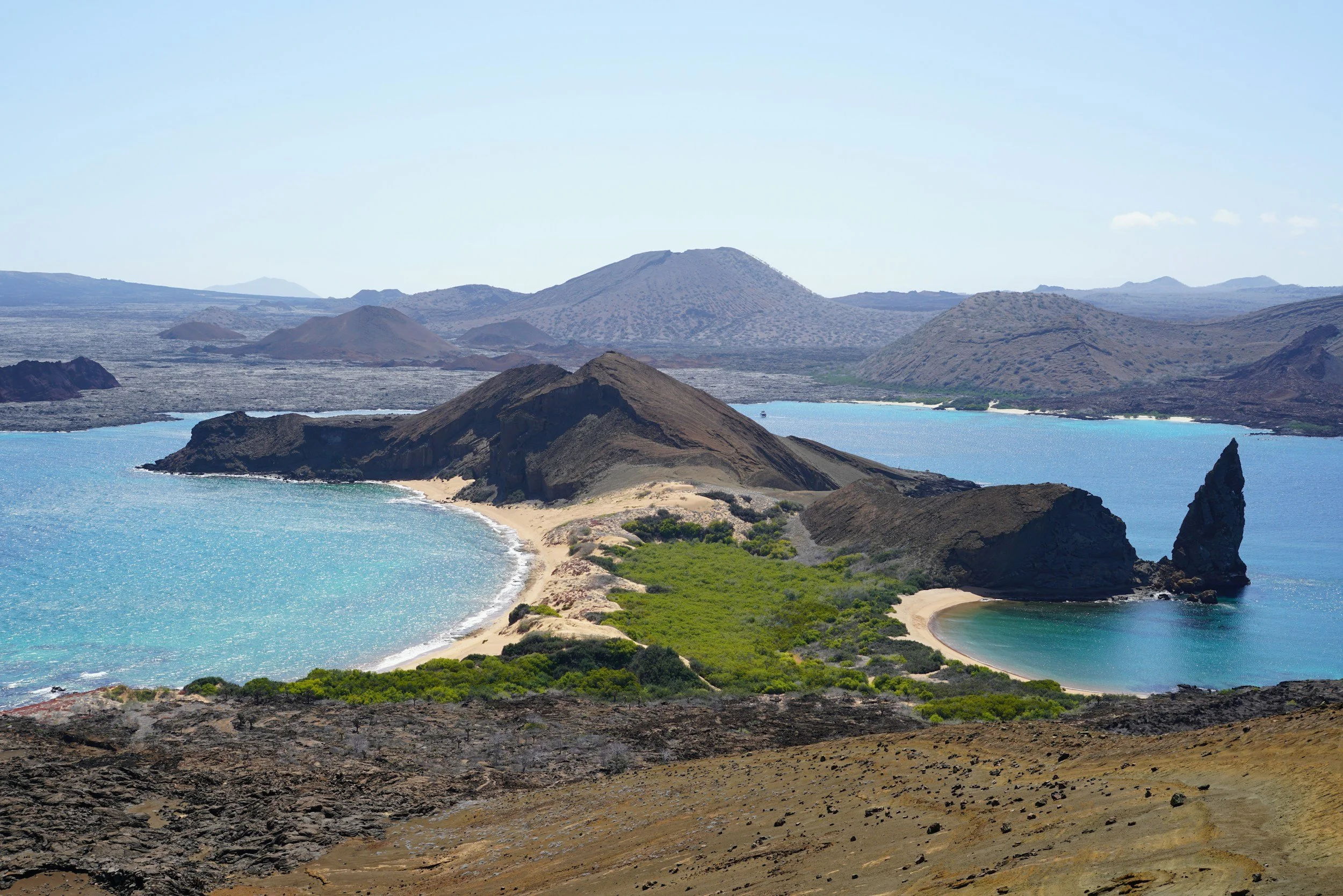
Galapagos Islands
01 — LIZARD ISLAND, AUSTRALIA — GREAT BARRIER REEF
Lizard Island is the northernmost resort on Australia's Great Barrier Reef — 240 kilometres north of Cairns, arrived at by a scenic flight over 200 kilometres of reef. A Relais & Châteaux property of forty rooms, it exists at the precise intersection of spectacular natural environment and genuine luxury.
The island's resident naturalist leads what the resort calls a 'twitching tour' — a guided walk through the property identifying the native species that call the island home year-round. The Sacred Kingfisher, electric blue and rust, perches on low branches and dives with extraordinary precision. The Rose-Crowned Fruit Dove, one of Australia's most beautiful birds, moves through the canopy in flashes of rose, green, and gold. The Rainbow Bee-Eater — possibly the most aptly named bird in existence — catches insects mid-flight with an acrobatic confidence that makes you stop walking mid-step.
What makes Lizard Island exceptional is not any single species. It is the quality of immersion. You are not a visitor observing wildlife from behind a fence. You are a guest on an island that belongs, primarily, to its birds, its reef, and its extraordinary marine life. The birdwatching walk happens on the morning of departure — a deliberate design choice that sends you back into your life having spent your final hours in pure, unhurried attention.
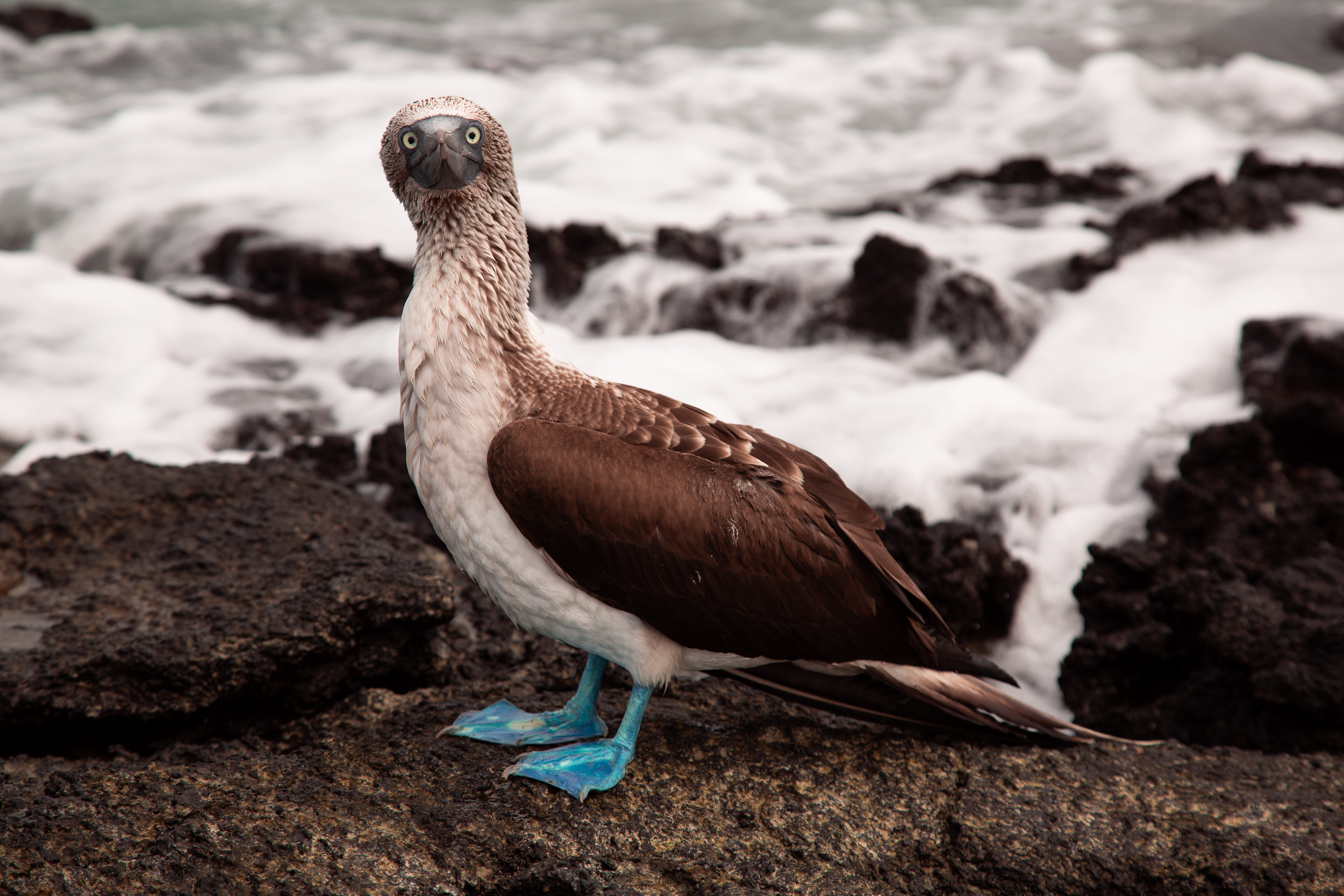
Blue-footed booby, Galápagos
02 — THE GALÁPAGOS ISLANDS, ECUADOR — A PLACE FOUND NOWHERE ELSE
Charles Darwin arrived in the Galápagos in 1835 and left with the conceptual framework for what would become On the Origin of Species. The birds did that to him. The same birds are still there.
The Galápagos archipelago is one of the last places on Earth where wildlife has no evolutionary reason to fear humans. The animals are not tame — they are simply unafraid. A Galápagos hawk will land a metre from your feet and regard you with complete composure. A colony of blue-footed boobies will perform their extraordinary mating dance — feet raised, wings spread, a waddle of absolute conviction — entirely regardless of your presence.
The endemic species are the point. The flightless cormorant, found only here, has lost the use of its wings entirely — it fishes instead by diving, its vestigial wings held out to dry afterwards in a posture of almost comic dignity. The waved albatross of Española Island has a wingspan of nearly two and a half metres and performs a mating ritual so elaborate it looks choreographed. The vermilion flycatcher — the male a flash of impossible red against volcanic black rock — is a bird so beautiful it reads as fictional.
For the Galápagos at its most intimate, the Hermès mega-catamaran carries just twenty guests through the archipelago. Twenty people. The islands are undisturbed. Three nights moving between South Plaza, Santa Fe, Genovesa — each one a different evolutionary experiment, each one unlike anywhere else on Earth.
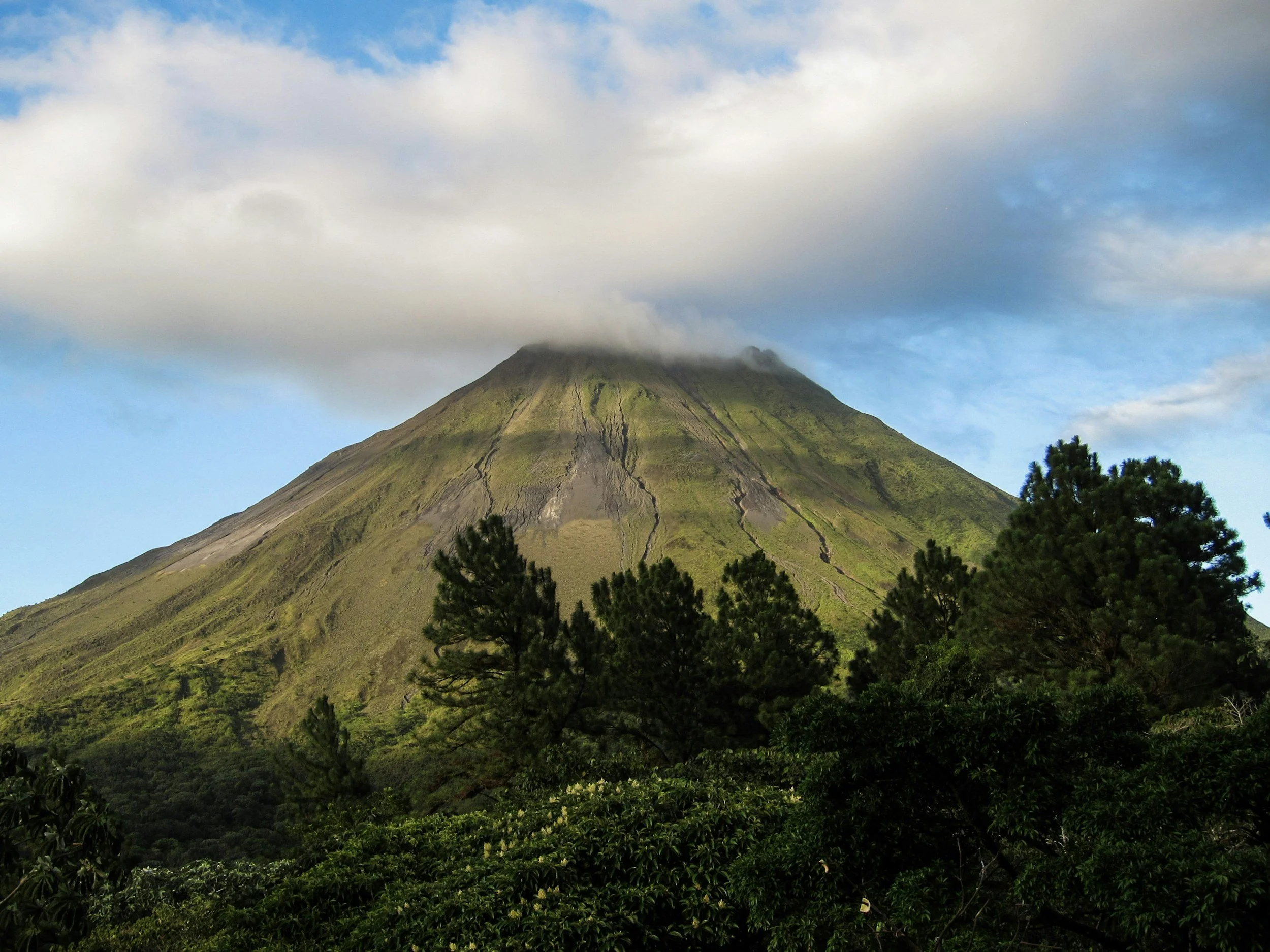
Arenal Volcano, Costa Rica
03 — THE AMERICAS BY PRIVATE JET — WILDERNESS ACROSS A CONTINENT
The Wildlife & Natural Wonders of the Americas expedition — sixteen days, an Airbus A321 with flatbed seats, five destinations — is built around a single principle: that the natural world, encountered at depth, changes people.
At Arenal Volcano National Park, Costa Rica, the rainforest night tour is unlike anything available in daylight. As darkness falls over the volcano, the forest's nocturnal population begins to move. Sloths, motionless by day, become visible in the canopy. Howler monkeys settle into their night calls. And the birds — toucans roosting, nightjars hunting moths, the extraordinary resplendent quetzal if the timing is right — reveal a world that most visitors never see.
In the Amazon Rainforest, Brazil, navigation of the Rio Negro reveals the Cocoi Heron — one of the largest herons in the world — standing motionless at the waterline, waiting. Pink dolphins surface alongside the boat. The soundscape alone — layered, continuous, alive — is enough to understand why this place is called the lungs of the Earth.
And then the Galápagos again, this time arriving by private jet to Guayaquil before boarding a chartered flight to the islands, where the journey has been building to all along.
The expedition runs June 15–30, 2027. Fifty-two guests maximum. An emergency-room physician travels with the group. So does an onboard photographer, a naturalist, and a chef.

Custom Airbus A321 interiors
The question birdwatching asks of you
I want to be honest about something. I came to birdwatching slowly, and not entirely by choice. It was the landscape that insisted — the Antarctic seabirds tracking the ship at dawn during my years with HX Hurtigruten Expeditions, the albatrosses so large and so effortless they seemed to belong to a different physics. You cannot work in those environments without beginning to pay attention.
What I discovered, gradually, was that the quality of attention birdwatching requires is the same quality of attention that makes everything else better. The listening before speaking. The patience before concluding. The willingness to be still long enough for something real to appear.
These are not decorative qualities. They are the qualities that distinguish the advisors, the leaders, and the decision-makers who last from those who burn out. And they are qualities that travel — the right kind of travel, in the right kind of place — can restore.
You do not need to call yourself a birdwatcher.
You only need to be willing to stop, look up, and pay attention to something that has nothing to do with your agenda.
If this resonates — if there is a journey somewhere in this that you have been imagining without quite naming — I would be glad to begin the conversation.
JOURNEY WITH AURA VERA
-
Airbus A321 flatbed · 16 days · Banff · Yellowstone · Arenal · Amazon · Galápagos · Sea of Cortez.
From $135,000 per person, all-inclusive. An expedition built around wildlife, wilderness, and the particular quality of attention that only certain places create.
-
Twenty guests. South Plaza · Santa Fe · Genovesa · Santa Cruz · Chinese Hat.
Three nights among the endemic species Darwin studied. Intimate, unhurried, unrepeatable.
-
Forty rooms on the northernmost island of the Great Barrier Reef.
Guided naturalist birdwatching. Sacred Kingfisher · Rose-Crowned Fruit Dove · Rainbow Bee-Eater. A place that belongs, primarily, to its birds and its reef.
Describe the feeling. I will find the place.